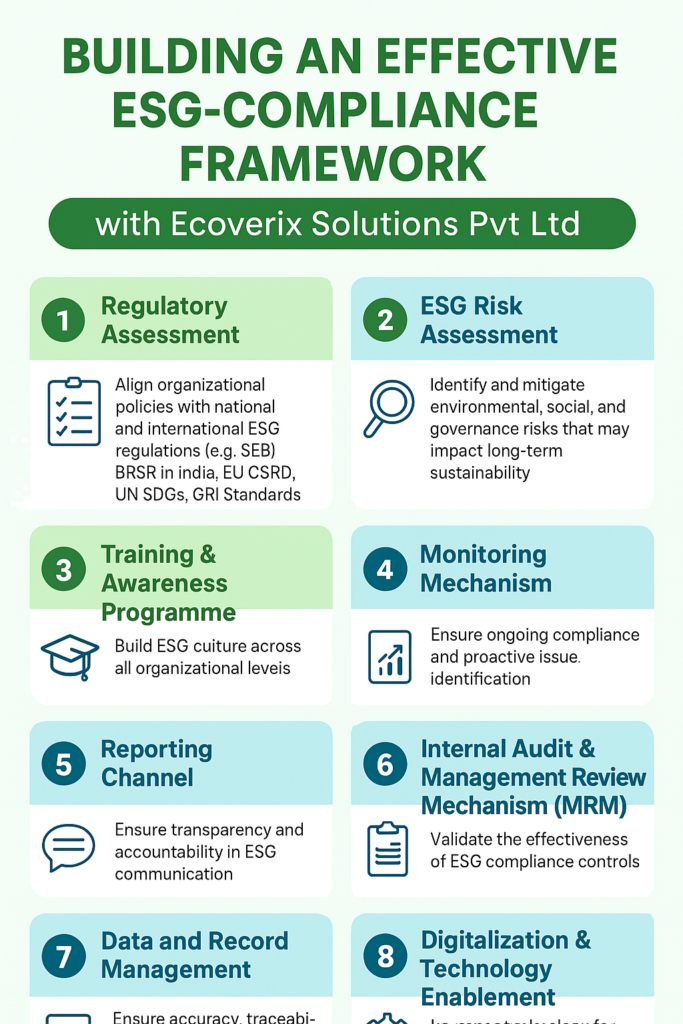

In today’s business environment, Environmental, Social, and Governance (ESG) compliance has become a strategic imperative rather than a voluntary commitment. Investors, regulators, customers, and stakeholders expect organizations to demonstrate measurable ESG performance supported by strong governance systems. To achieve this, organizations need a robust ESG-Compliance Framework that integrates risk management, accountability, and continuous improvement.
Below are the essential pillars of such a framework:
1. Regulatory Assessment
- Objective: Align organizational policies with national and international ESG regulations (e.g., SEBI BRSR in India, EU CSRD, UN SDGs, GRI Standards).
- Key Steps:
- Map applicable laws, disclosure requirements, and sector-specific ESG obligations.
- Benchmark practices against global standards.
- Establish a compliance calendar for timely submissions.
2. ESG Risk Assessment
- Objective: Identify and mitigate environmental, social, and governance risks that may impact long-term sustainability.
- Approach:
- Conduct materiality assessments to prioritize ESG risks (e.g., carbon footprint, supply chain labor practices, governance lapses).
- Integrate ESG risk into Enterprise Risk Management (ERM) frameworks.
- Apply scenario analysis for climate-related financial risks (as per TCFD recommendations).
3. Training & Awareness Programme
- Objective: Build ESG culture across all organizational levels.
- Execution:
- Conduct workshops on ESG compliance, ethical business conduct, and sustainability goals.
- Develop role-specific training modules (board, management, operations, suppliers).
- Encourage employee participation in sustainability initiatives.
4. Monitoring Mechanism
- Objective: Ensure ongoing compliance and proactive issue identification.
- Components:
- Real-time ESG performance dashboards.
- Key Performance Indicators (KPIs) tied to sustainability goals.
- Regular site inspections, supplier audits, and third-party validations.
5. Reporting Channel
- Objective: Ensure transparency and accountability in ESG communication.
- Implementation:
- Create internal reporting mechanisms for employees to raise ESG-related concerns (e.g., whistleblower hotlines).
- Develop standardized ESG reports aligned with frameworks like GRI, SASB, and Integrated Reporting (IR).
- Disclose ESG metrics in annual sustainability reports or Business Responsibility and Sustainability Reports (BRSR).
6. Internal Audit & Management Review Mechanism (MRM)
- Objective: Validate the effectiveness of ESG compliance controls.
- Process:
- Integrate ESG into the scope of internal audits.
- Conduct periodic Management Review Meetings (MRM) to evaluate ESG objectives, targets, and gaps.
- Use audit findings to drive corrective and preventive actions.
7. Data and Record Management
- Objective: Ensure accuracy, traceability, and consistency of ESG data.
- Best Practices:
- Maintain centralized ESG data repositories.
- Standardize data collection formats across departments.
- Implement version controls and audit trails for records.
8. Digitalization & Technology Enablement
- Objective: Leverage technology for efficient ESG governance.
- Tools:
- AI-driven platforms for carbon accounting and ESG risk analytics.
- Blockchain for supply chain transparency.
- Cloud-based ESG compliance management systems for real-time monitoring and reporting.
Conclusion
An ESG-Compliance Framework is not just a governance requirement but a value-creation tool. By embedding regulatory alignment, risk assessment, training, monitoring, reporting, auditing, data governance, and digitalization into their ESG journey, organizations can achieve:
- Stronger stakeholder trust
- Improved regulatory readiness
- Enhanced long-term resilience
- Competitive advantage in global markets
🚀 Why Choose Ecoverix?
✔️ Multidisciplinary Team of Sustainability Experts, Energy Auditors, Lead ESG Consultants, and Regulatory Specialists
✔️ Experience in Global Standards, Compliance, and Frameworks
✔️ Holistic Solutions Integrating Operations, Supply Chain, and Corporate Governance
✔️ Proven Record in Driving Net-Zero Goals, Waste Reduction, and Water Efficiency Projects
✔️ Deep Industry Expertise Across Manufacturing & Infrastructure Sectors
🌍 Build a Better Tomorrow. Start Today.
Partner with Ecoverix Solutions to transition your business toward a more sustainable, responsible, and profitable future.
📩 Reach out to us at avneesh@ecoverix.com, sonunavaljha@ecoverix.com
🔗 Let’s build ESG-led impact, together