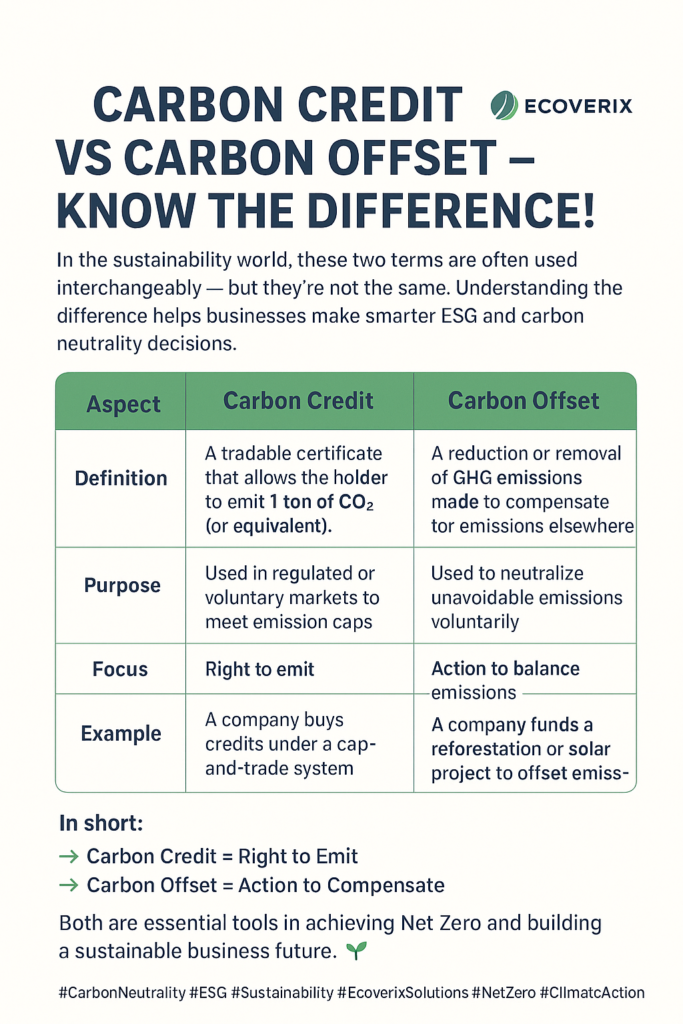







A carbon credit is a permit or certificate that allows the holder to emit one metric ton of carbon dioxide (CO₂) or its equivalent amount of another greenhouse gas.
It is used under regulated or voluntary carbon markets to control and reduce emissions.
✅ Example:
Suppose a power plant is allowed to emit 1,00,000 tons of CO₂ per year under government regulations.
If it emits only 90,000 tons, it has 10,000 tons worth of unused credits.
The company can sell these 10,000 carbon credits to another company that exceeded its emission limit.
This creates a “cap-and-trade” system — rewarding low emitters and penalizing high emitters.
🌿 What is a Carbon Offset?
A carbon offset refers to reducing or removing greenhouse gas emissions from the atmosphere to compensate for emissions made elsewhere.
Offsets are usually voluntary and often linked to environmental projects.
✅ Example:
A manufacturing company emits 5,000 tons of CO₂ each year.
To neutralize its footprint, it funds a reforestation project that absorbs an equivalent 5,000 tons of CO₂.
Now, even though the company still emits carbon, its net impact becomes zero — this is called being carbon neutral through offsetting.
⚖️ Summary
Carbon Credit = Right to Emit
Carbon Offset = Action to Compensate
Both are vital tools for companies aiming to achieve Net Zero and align with ESG and sustainability goals. 🌱
❓ 1. What is a Carbon Credit?
A carbon credit is a tradable certificate that gives the holder the right to emit one metric ton of carbon dioxide (CO₂) or its equivalent amount of other greenhouse gases (GHGs).
It is used in cap-and-trade systems to help industries control and reduce their emissions.
❓ 2. What is a Carbon Offset?
A carbon offset represents a reduction or removal of GHG emissions from the atmosphere, made to compensate for emissions produced elsewhere.
Offsets are often achieved through projects like reforestation, renewable energy, or methane capture.
❓ 3. What is the difference between a Carbon Credit and a Carbon Offset?
- Carbon Credit = Right to emit (a compliance mechanism).
- Carbon Offset = Action to neutralize emissions (a voluntary mechanism).
Credits are used under regulatory frameworks, while offsets are typically voluntary.
❓ 4. How do Carbon Credits work?
Governments or regulatory bodies set a cap on total emissions.
Companies that emit less than their cap can sell excess credits to others who emit more — creating a market incentive to reduce emissions efficiently.
❓ 5. How do Carbon Offsets work?
Companies or individuals calculate their total carbon footprint and then fund emission reduction projects equivalent to their emissions — achieving carbon neutrality.
❓ 6. What types of projects generate Carbon Offsets?
Common offset projects include:
🌱 Reforestation & afforestation
☀️ Renewable energy (solar, wind, hydro)
♻️ Waste management and methane capture
🏭 Energy efficiency projects
🌾 Soil carbon sequestration in agriculture
❓ 7. Who verifies Carbon Credit and Offset projects?
Projects are verified and certified by recognized international standards such as:
- Gold Standard
- Verified Carbon Standard (VCS)
- CDM (Clean Development Mechanism)
- Climate Action Reserve (CAR)
Verification ensures that emission reductions are real, measurable, and permanent.
❓ 8. What are Voluntary and Compliance Carbon Markets?
- Compliance Market: Operates under legal frameworks like the EU Emissions Trading System (EU ETS) or Kyoto Protocol.
- Voluntary Market: Businesses or individuals voluntarily purchase offsets to go beyond compliance or achieve net-zero.
❓ 9. Why are Carbon Credits and Offsets important?
They help organizations:
- Meet regulatory emission limits
- Demonstrate ESG leadership
- Support climate-positive projects
- Progress toward Net Zero goals
❓ 10. What are the risks or challenges with Carbon Offsets?
- Double counting of emission reductions
- Poor verification or “greenwashing” claims
- Short-term impact if projects aren’t sustained
That’s why transparency and third-party verification are critical.
❓ 11. How can Indian companies participate?
Companies can:
Connect with Ecoverix for Energy, ESG Project implementation, #ESG #Sustainability #ISO14001 #ISO50001 #CorporateGovernance #EcoverixSolutions #ResponsibleBusiness #SustainabilityReporting
- Invest in renewable or afforestation projects.
- Partner with BEE or ESG consultants like Ecoverix Solutions Pvt. Ltd. to develop verified carbon strategies.