


ISO CERTIFICATION & COMPLIANCES
ISO certifications are awarded to organizations that meet the International Organization for Standardization's (ISO) standards for Quality, Environment, Energy Safety, Supply chain and efficiency in their products, services, and operations. These certifications demonstrate that a company has implemented and maintained a management system that meets international standards.
ISO certifications can benefit organizations in several ways:
1. Improved credibility and reputation.
2. Access to new markets.
3. Cost savings.
4. Enhanced customer satisfaction.
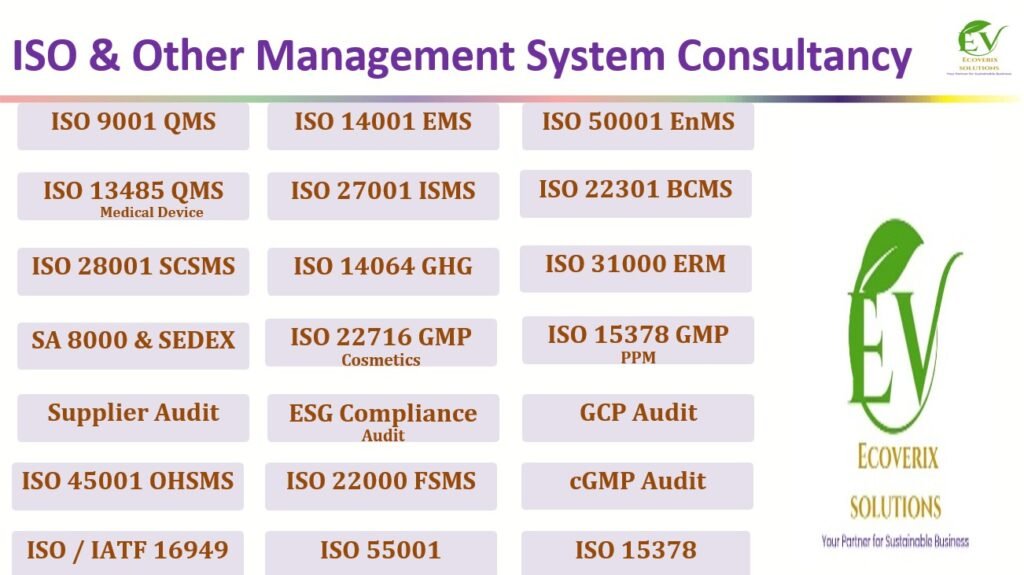
Ecoverix will help organizations to establish ISO systems by providing expertise in the following areas:
1. Gap analysis:
Ecoverix will conduct a thorough assessment of the organization's current processes and systems to identify gaps and areas for improvement to meet ISO standards.
2. Implementation planning:
Ecoverix will help develop a detailed plan for implementing ISO standards, including establishing processes, documentation, and training programs.
3. Training and education:
Ecoverix will provide training and education to employees on ISO standards and the requirements for compliance.
4. Documentation:
Ecoverix will assist in developing the necessary documentation, including policies, procedures, and records required for ISO certification.
5. Internal audits:
Ecoverix will conduct internal audits to assess the organization's compliance with ISO standards and identify areas for improvement.
Ecoverix play a crucial role in guiding organizations through the process of establishing ISO systems, ensuring that they meet the necessary requirements for certification and achieve the associated benefits
ISO 9001
ISO 9001 is the globally recognized standard for Quality Management established by the International Organization for Standardization (ISO). Any organization, regardless of its size or industry, can reap the benefits of implementing ISO 9001. For those new to ISO Certification, ISO 9001 serves as an excellent starting point.
It is not only the most widely adopted standard worldwide, but is also serves as the foundation for many other standards, simplifying the process of integrating multiple standards.
The ISO 9001 Quality Management System (QMS) offers a standardized approach to operations, ensuring that your products or services consistently meet the expectations and needs of your customers. Elevating your QMS to meet the ISO requirements will enhance your business performance, fortifying it against future challenges. Additionally, it can lead to an increase in market share and profit potential.
ISO 9001 can help your organisation:
boost profits
win new business
retain existing customers
identify gaps in your processes
implement consistent, repeatable processes
stand out from your competitors
prepare for the future
spend less time completing tenders
engage employees
continually improve your business.
ISO 27001
The International Organization for Standardization (ISO) 27001 focuses on Information Security Management Systems (ISMS). Safeguarding confidential and sensitive information is crucial for business success, which is why ISO 27001 aims to minimize the risk of data breaches. Compliance with ISO 27001 is essential as it helps individuals achieve their primary objectives. This framework allows organizations to effectively manage the security of assets like financial information and data entrusted by third parties. Participants who receive ISO 27001 training from us will become highly skilled Information Security Professionals, increasing their chances of passing the exam on their first attempt.
Benefits of ISO 27001:
1. Increase your organization's credibility and cyber resilience.
2. Protect your reputation and avoid regulatory fines.
3. Improve information security structure and focus.
4. Enhance global appeal and facilitate adoption of more frameworks.
5.Improve compliance frameworks and reduce the need for audits.
6. It helps build a sustainable structure.
7. Enhances trust.
8.Improves efficiency.
9. Helps continuously monitor and prevent security risks.
ISO 14001 (ENIVORNMENTAL MANAGEMENT SYSTEM)
The ISO 14001 standard is an internationally recognized framework that offers practical tools for organizations to effectively manage their environmental responsibilities. This standard can be utilized by any organization, regardless of its industry or sector, to establish a structured framework for developing a competitive environmental management system. By implementing ISO 14001, organizations can identify and systematically reduce potentially harmful impacts on the environment.
ISO 14001 places a strong emphasis on enhancing environmental performance rather than solely focusing on improving the management system. This standard highlights the importance of leadership engagement and the necessity to comprehend the context of ISO 14001 in order to effectively manage risks and promote environmental management practices.
Benefits of implementing ISO 14001:
1.Improve Tender Chances
2.Leaders in Industry
3.Ensure Legal Compliance
4.Reduce Insurance Premiums
5.Improve Environmental
6.Performance
7.Reduce Operational Waste
8.Increase Profitability
9.Increase Efficiency
10.Improve Employee Morale
11.Promotes Continual Improvement
ISO 50001 (ENERGY MANAGEMENT SYSTEM)
The International Organization for Standardization (ISO) released ISO 50001 in June 2011 as an international standard for energy management systems. This standard provides organizations with a structured framework to effectively manage energy consumption and outlines requirements for a systematic, data-driven approach focused on enhancing energy performance.
ISO 50001 encourages the implementation of best practices in energy management and promotes positive energy management behaviors. The standard has the potential to impact up to 60% of global energy usage, making it relevant across various economic sectors worldwide.
In August 2018, the ISO 50001 standard underwent revisions and updates. These changes included aligning the standard with a high-level structure, enhancing integration with strategic management processes, placing greater emphasis on the role of top management, introducing concepts like normalization and energy data collection plans, among others. The 2018 version of ISO 50001 elevates energy management practices by enabling organizations to adopt a strategic approach that integrates energy management seamlessly into their business processes.
Benefits of implementing ISO 50001:
1.Reducing energy consumption
2.Cost Reduction
3.Mitigating effects of climate change
4.Improved brand image and credibility
5.Increased Awareness
6.Improved management and decision making
ISO 45001 (OCCUPATIONAL HEALTH AND SAFETY)
ISO 45001 is a comprehensive standard aimed at preventing work-related injuries and illnesses, as well as ensuring safe and healthy workplaces. Implementing an effective occupational health and safety management system is crucial in safeguarding your most valuable asset - your employees - and driving business success.
This international standard, ISO 45001, transcends geographical, political, economic, commercial, and social boundaries, providing a universal benchmark for occupational health and safety management. By adhering to this standard, organizations operating or trading globally can streamline their processes and operations.
For those new to occupational health and safety management, ISO 45001 offers a solid framework to enhance organizational resilience and ensure compliance with industry best practices. Incorporating this standard into your business practices can lead to improved safety outcomes and overall business performance.
Benefits of ISO 45001:
1.Improve employee safety
2.Boost stakeholder confidence
3.Increased productivity
4.Lower insurance costs
5.Foster management involvement & accountability
6.Reduce risk
7.Identify opportunities
8.Stand out as an industry leader
9.Gain a competive advantage
10. Engage employees in safety
11. Shift from reactive to proactive
12.Demonstrate your commitment to safety
ISO 22000(FOOD SAFETY MANAGEMENT)
Utilized by organizations throughout the food industry to ensure the delivery of safe food, ISO 22000:2018 serves as a valuable framework for implementing a Food Safety Management System (FSMS). Currently, ISO 22000 is in the process of transitioning to the updated version, ISO 22000:2018.
The landscape of food production, transportation, manufacturing, and consumption has evolved significantly since the original standard was introduced more than a decade ago. The new version of the standard takes these changes into account and aims to assist organizations in mitigating food safety risks.
In addition to enhancing the compatibility of ISO 22000 and the resulting FSMS with other ISO management systems, the updated standard introduces the Plan-Do-Check-Act (PDCA) cycle and risk-based thinking. By integrating PDCA and risk-based thinking to manage business risks alongside HACCP principles to identify, prevent, and control food safety hazards, ISO 22000 enables organizations to minimize exposure to risks and enhance safety measures.
Benefits of implementation of ISO 22000:
1.Brings forth more profit
2.Reduces costs
3.Increases trust of the customer in your food customers
4.Allow taking necessary actions at the right time to prevent any risks or defects
5.Improvement in the utilization of resources
6.Fewer error and customer complaints.
7.Compliance with legal requirements.
FAQ – ISO Consultancy & Compliance Services
1. What ISO consultancy services does Ecoverix Solutions offer?
We provide end-to-end ISO consultancy services including documentation, training, implementation, internal audits, and certification support for:
ISO 9001 – Quality Management System
ISO 14001 – Environmental Management System
ISO 45001 – Occupational Health & Safety Management System
ISO 50001 – Energy Management System
ISO 13485 – Medical Devices Quality Management System
ISO 22000 – Food Safety Management System
We also offer support for SEDEX SMETA Audits, EcoVadis Sustainability Rating, and cGMP Compliance.
2. Why should my organization implement ISO standards?
ISO certification helps businesses:
Improve quality, efficiency, and customer satisfaction
Meet regulatory and statutory compliance
Enhance brand reputation and market credibility
Reduce operational risks and costs
Access global markets and supply chains
3. What is the process for ISO certification?
Our ISO consultancy process typically includes:
Gap Analysis – Assess current systems against ISO requirements
Documentation – Prepare manuals, SOPs, and process documents
Training – Equip your team with ISO knowledge
Implementation – Roll out ISO-compliant processes
Internal Audit – Ensure readiness for certification
Certification Audit Support – Liaison with accredited bodies
4. What is SEDEX SMETA Audit and why is it important?
SEDEX SMETA (Sedex Members Ethical Trade Audit) is an ethical trade audit that covers labor standards, health & safety, environment, and business ethics. It is essential for suppliers working with global brands that require ethical sourcing compliance.
5. What is EcoVadis and how can it benefit my company?
EcoVadis is a sustainability rating platform that evaluates your company’s environmental, social, and ethical performance. A good EcoVadis score can improve your chances of winning contracts with sustainability-focused clients.
6. What is cGMP compliance and how do you support it?
cGMP (Current Good Manufacturing Practices) ensures products are consistently produced and controlled according to quality standards. We help you:
Prepare cGMP documentation
Train staff on GMP compliance
Conduct mock audits for FDA, WHO, EU GMP inspections
7. How long does it take to get ISO certified?
The timeline depends on the ISO standard and your organization’s readiness. On average:
Small organizations: 2–3 months
Medium to large organizations: 4–6 months
8. Can Ecoverix Solutions help with multiple ISO certifications at once?
Yes. We specialize in Integrated Management System (IMS) implementation, combining multiple ISO standards like ISO 9001, ISO 14001, ISO 45001 into a single, efficient management system.
9. Are your ISO consultancy services industry-specific?
We provide ISO consultancy across industries including:
Pharmaceutical & Medical Devices
Food & Beverage
Manufacturing & Engineering
Energy & Utilities
Packaging & FMCG
10. Why choose Ecoverix Solutions for ISO consultancy?
Experienced ISO consultants with multi-industry expertise
Tailored solutions for your business needs
Proven track record of successful certifications
Support for global standards and audits
Focus on long-term compliance and operational excellence
ISO consultancy services India
ISO certification company India
ISO documentation and audit support
Best ISO consultants in India
ISO training and implementation services
Accredited ISO certification consultancy
End-to-end ISO certification support
ISO audit preparation services
ISO 9001 certification consultancy
ISO 9001 QMS implementation services
ISO 9001 documentation and audit support
ISO 50001 energy management consultancy
ISO 50001 certification and audit services
ISO 45001 occupational health and safety consultancy
ISO 45001 certification and training services
ISO 14001 environmental management consultancy
ISO 14001 certification support services
SEDEX SMETA audit preparation services
Ethical trade audit consultancy India
EcoVadis sustainability rating consultancy
EcoVadis score improvement services
cGMP compliance consultancy
cGMP documentation and training services
ISO certification in Uttarakhand
ISO consultants in Haridwar
ISO 9001 certification Uttarakhand
ISO 14001 certification Dehradun
ISO 45001 certification Rudrapur
ISO certification in Uttar Pradesh
ISO consultants in Noida
ISO 9001 certification Lucknow
ISO 14001 certification Ghaziabad
ISO 45001 certification Kanpur
ISO certification in Himachal Pradesh
ISO consultants in Baddi
ISO 9001 certification Solan
ISO 14001 certification Shimla
ISO certification in Punjab
ISO consultants in Ludhiana
ISO 9001 certification Amritsar
ISO 14001 certification Jalandhar
- What is ISO certification and why is it important?
- What are the different types of ISO standards (like ISO 9001, ISO 14001, ISO 45001 etc.)?
- How long does it take to get ISO certified?
- How much does ISO certification cost?
- What is the ISO certification process (steps involved)?
- What documents are required for ISO certification?
- Who can apply for ISO certification (which types of organizations)?
- How to choose a certification body / auditor?
- What are the ongoing obligations after obtaining ISO certification (surveillance audits, recertification etc.)
- How can we prepare efficiently for ISO certification?
- How to Prepare for ISO Audit in 10 Steps
- What does an ISO consultant do?
- How do I choose a good ISO consultant? What should I ask them?
- What is the cost of hiring an ISO consultant?
- What qualifications / experience should a good ISO consultant have?
- How long will it take with a consultant’s help to become ISO certified?
- What is the difference between a consultant and a certification body?
- Can a consultant help with gap analysis / document preparation / internal audit training?
- What are hidden costs in ISO implementation (besides just the certification fees)?
- Do I need full-time staff for maintaining ISO, or can I outsource certain tasks to a consultant?
- How do I ensure that the consultancy results in real process improvements, not just paperwork?
- ISO Management Consultant in Bangalore
- ISO Management Consultant in Mumbai
- ISO Management Consultant in Chennai
- ISO Management Consultant in Delhi
- ISO Management consultant in Hyderabad
- ISO Management Consultant in Pune
- ISO Management Consultant in Ahmedabad
- ISO Management Consultant in Lucknow
- ISO Management Consultant in Patna
- ISO Management Consultant in Jaipur
- ISO Management Consultant in Indore
- ISO Management Consultant in Kochi
- ISO Management Consultant in Kolkata
- ISO Management Consultant in Coimbatore
- ISO Management Consultant in Nagpur
- ISO Management consultant in Ludhiana
- ISO Management Consultant in Agra
- ISO Management Consultant in Bhubaneshwar
- ISO Management Consultant in Bhopal
- ISO Management Consultant in Guwahati
- ISO Management Consultant in Surat
- ISO Management Consultant in Madurai
- ISO Management Consultant in Visakhapatnam
- ISO Management Consultant in Sonepat
- ISO Management Consultant in Vadodara
- ISO Management Consultant in Meerut
- ISO Management Consultant in Thiruvananthapuram
- ISO Management Consultant in Gurgaon
- ISO Management Consultant in Kozhikode
- ISO Management Consultant in Varanasi
- ISO Management Consultant in Siliguri
- ISO Management Consultant in Allahabad
- ISO Management Consultant in Rajkot
- ISO Management Consultant in Ghaziabad
- ISO Management Consultant in Mysore
- ISO Management Consultant in Noida
- ISO Management Consultant in Chandigarh
- ISO Management Consultant in Navi-Mumbai
- ISO Management Consultant in Vijayawada
- ISO Management Consultant in Durgapur
- ISO Management Consultant in Srinagar
- ISO Management Consultant in Nashik
- ISO Management Consultant in Panipat
- ISO Management Consultant in Jammu
- ISO Management Consultant in Jodhpur
- ISO Management Consultant in Udaipur-Rajasthan
- ISO Management Consultant in Thane
- ISO Management Consultant in Raipur-Chhattisgarh
- ISO Management Consultant in Amritsar
- ISO Management Consultant in Jabalpur