

1️⃣ Green Financing
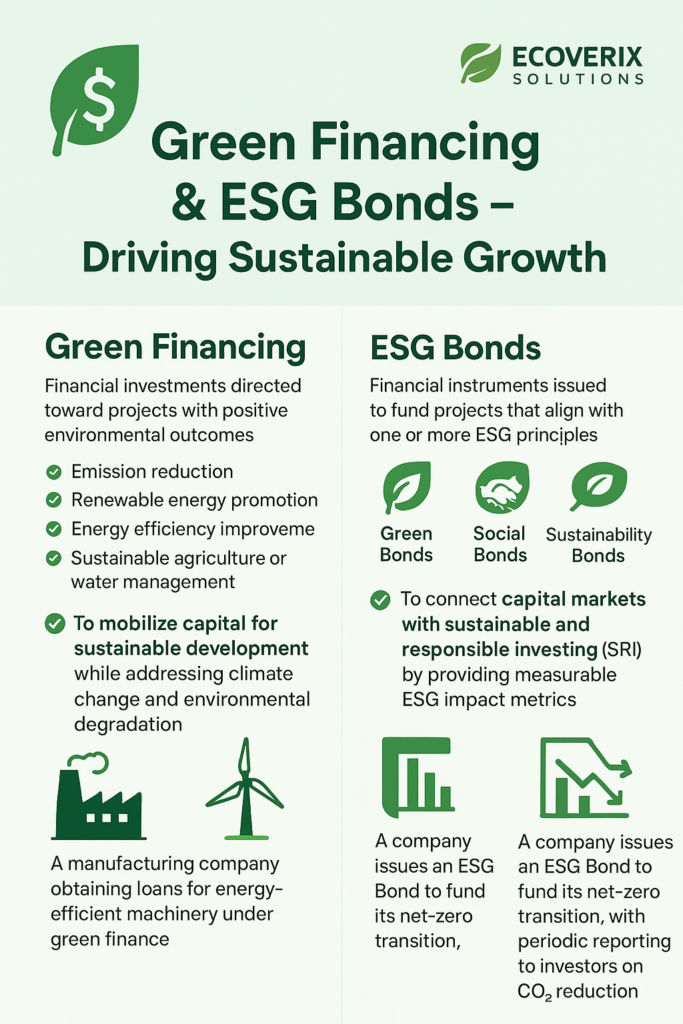
Green Financing refers to financial investments that are specifically directed toward projects or initiatives that have positive environmental outcomes.
These include efforts to:
1-Reduce carbon emissions
2-Promote renewable energy
3-Improve energy efficiency
4-Support sustainable agriculture or water management
5-Enable climate adaptation and biodiversity conservation
✅ Key Objective:
To mobilize capital for sustainable development while addressing climate change and environmental degradation.
💡 Examples:
A manufacturing company obtaining loans for energy-efficient machinery under green finance.
Banks offering green credit lines for solar rooftop installations or EV adoption.
2️⃣ ESG Bonds (Environmental, Social & Governance Bonds)
ESG Bonds are financial instruments issued to fund projects that align with one or more ESG principles — Environmental, Social, or Governance.
They include several categories:
🌱 Green Bonds: Finance projects with environmental benefits (e.g., renewable energy, waste management).
🤝 Social Bonds: Fund projects that improve social outcomes (e.g., affordable housing, education, healthcare).
⚖️ Sustainability Bonds: Combine both green and social objectives.
📊 Sustainability-Linked Bonds (SLBs): Tied to the issuer’s sustainability performance targets (e.g., CO₂ reduction goals).
✅ Key Objective:
To connect capital markets with sustainable and responsible investing (SRI) by providing measurable ESG impact metrics.
💡 Example:
A company issues an ESG Bond to fund its net-zero transition, with periodic reporting to investors on CO₂ reduction achieved.
🧭 Link Between Green Finance & ESG Bonds
Green Finance is the umbrella concept, covering all forms of environmentally responsible financial support.
ESG Bonds are specific instruments under this umbrella used to raise funds for ESG-aligned projects.
🔗 Together, these mechanisms bridge capital markets with sustainability goals, supporting global frameworks like the UN SDGs and SEBI BRSR in India.
Procedure for Green Financing & ESG Bonds
I. Green Financing Procedure
Green financing follows a structured process to ensure the funds are used for genuine environmental benefits.
Step 1: Identify Eligible Green Projects
Select projects with measurable environmental benefits, such as:
- Renewable energy (solar, wind, bioenergy)
- Energy efficiency improvements
- Water conservation or wastewater treatment
- Sustainable agriculture or forestry
- Pollution prevention and control
📘 Reference Frameworks:
- UN SDGs (Goal 7, 12, 13)
- ISO 14001 (Environmental Management System)
- ISO 50001 (Energy Management System)
Step 2: Develop a Green Finance Framework
Document how funds will be used, managed, and reported.
This framework should include:
- Project selection criteria
- Process for evaluation
- Management of proceeds
- Reporting and verification mechanisms
📘 Reference: ICMA Green Bond Principles (GBP)
Step 3: Secure Green Financing from Lenders/Institutions
Approach financial institutions offering green credit lines or green loans, such as:
- Development banks (e.g., World Bank, ADB, SIDBI)
- Commercial banks with sustainability-linked products
- Green venture capital or ESG funds
Prepare documentation:
- Project proposal with environmental impact
- Expected energy or carbon savings
- Third-party technical validation (optional)
Step 4: Implementation & Monitoring
Ensure funds are used strictly for approved green projects.
- Monitor KPIs: energy saved, CO₂ reduced, waste reduced.
- Conduct internal audits (align with ISO 14064 for GHG validation).
Step 5: Reporting & Verification
Publish periodic sustainability or impact reports.
Include:
- Project status
- Environmental metrics (e.g., tonnes CO₂ avoided)
- Independent assurance reports
II. ESG Bond Issuance Procedure
Step 1: Define ESG Strategy & Objectives
The organization should first align with ESG goals under:
- Environmental: Climate action, renewable energy
- Social: Education, gender equality, affordable housing
- Governance: Transparency, ethics, accountability
Prepare ESG policy or sustainability roadmap.
Step 2: Design ESG Bond Framework
Develop a document following ICMA’s Principles:
- Use of Proceeds
- Project Evaluation and Selection
- Management of Proceeds
- Reporting and Impact Metrics
This framework is shared with investors and rating agencies.
Step 3: Obtain External Review or Certification
Engage third-party verifiers such as:
- CICERO, Vigeo Eiris, or Sustainalytics
They assess the bond’s ESG alignment and issue a Second Party Opinion (SPO) or Green Bond Certification.
Step 4: Regulatory Approval and Listing
- File bond documents with regulators (e.g., SEBI in India).
- Bonds can be listed on ESG-focused exchanges such as the Luxembourg Green Exchange (LGX) or India INX ESG Platform.
Step 5: Issuance & Fund Allocation
Funds are raised and allocated strictly to eligible ESG projects.
Maintain clear segregation of proceeds and record utilization.
Step 6: Reporting & Impact Disclosure
Publish annual reports detailing:
- Project progress
- Allocation of funds
- ESG performance indicators (e.g., CO₂ reduction, beneficiaries reached)
- External verification statement
✅ Summary Table
| Stage | Green Financing | ESG Bond |
|---|---|---|
| Framework | Green Finance Policy | ESG Bond Framework |
| Funding Source | Banks, Development Institutions | Capital Markets (Investors) |
| Verification | Technical/Environmental Audit | Second Party Opinion / ESG Rating |
| Reporting | Sustainability Reports | Annual Impact Reports |
| Applicable Standards | ISO 14001, ISO 50001, ISO 14064 | ICMA GBP, SEBI ESG Norms, SDGs |
#GreenFinance #ESGBonds #Sustainability #ESG #BRSR #EcoverixSolutions #SustainableGrowth #ImpactInvestment #ClimateAction #SDGs